Hello, my name is Walter. I'm the summer student in the Employment Centre here at the Mustard Seed.
Recently Desiree, my neighbor, and I had an interesting discussion about hope, the topic of which has been a recurring theme for me this summer. She told me of her encounter on the previous day, on the streets of Calgary where she had witnessed humanity in its most savage, and depraved form. Two men had, without reasonable prompting, proceeded to pummel another man in the face. The police eventually arrived to break up the crowd, but with tempers flaring, their arrival only seemed to make things worse.
These kinds of angry street scenes seem to be common occurrences during my stay. From my open window downtown I regularly hear bouts of drunken rage, nicely garnished with horrific swear words and slurred threats.
Many of our guests have had traumatic life experiences, witnessed brutal and inhuman acts of injustice and lived in a violent world where alcohol is seen as the only logical form of escape. After living in such overbearing circumstances, I wonder if there ever comes a point in which a person can no longer be helped with his or her burden. When is that point reached in which they’ve almost lost their defining traits of humanity and simply become instinctive rage-induced beings? Many would argue that there is always a glimmer of hope in every human. Yet time and time again we seem to have visitors at our door who never change. They keep coming back where they erupt into explosions of rage over minor things, inflict unnecessary physical and emotional pain on others, and they seem to have withdrawn completely from the consequences of their actions. Can someone reach that point of no return? Or will there always be a glimmer of hope? I don’t claim to know the answer; I don’t think humans can know the answer.
What seems to matter though is the way we react. I can’t judge the reactions of those on the scene that weekend. Yet I strongly believe that harsh reactions go against everything the Mustard Seed believes in. We convey hope in our actions: if we are disrespectful to guests it may be interpreted that he or she is a hopeless cause, and when we show love then we project hope.
Maybe the question of hope doesn’t lie in whether or not humans can reach a point of no return but, instead, whether or not the people around these “hopeless causes” will act in a way that cultivates hope in their souls. During my time here I’ve realized that The Mustard Seed is on the forefront of projecting hope to the hopeless, yet there is always room for improvement. We should never stop wondering whether or not we’re growing hope or tearing it down with our actions.
Ask yourself, in your daily interactions are you being hopeful and loving with the people who least deserve it?
- Walter
Showing posts with label Neighbours. Show all posts
Showing posts with label Neighbours. Show all posts
Thursday, July 26, 2012


Friday, April 13, 2012
An Invitation
Whenever I'm spending time with our community in the drop-in I often wonder how newcomers to the neighbourhood, as well as the greater community of Edmonton, perceive our community with an "outsider" perspective. I mean, there are some reactions that I could predict: fear of the unknown, the perpetuation of stereotypes of the urban poor and the homeless, a desire to remain separated from those who are different... But maybe the people who regularly hang out in our drop-in facility and other agencies like it are not as different from us as we might think.
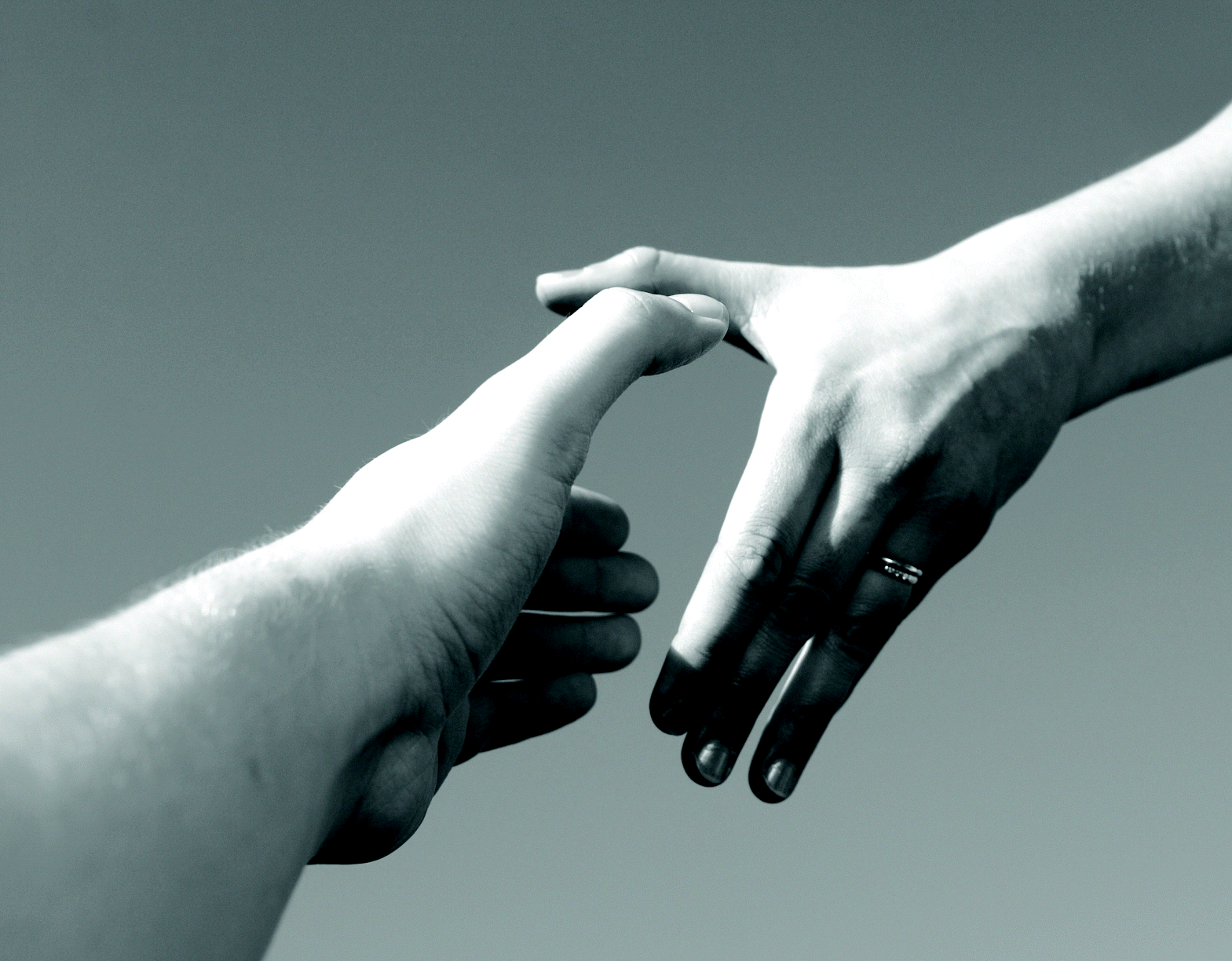
Our community is often said to be an unhealthy one, and for some that is most definitely true. For the recovering addict, the inner city could be just one big trigger. For the ex-gang member the inner city might represent flooding memories of intense violence. But not everyone from this neighbourhood is in recovery. There are some for whom this community is filled with deep and meaningful relationships, friends who have become more like family, people who give one another worth, and value, and meaning. In the midst of this dichotomous world of health and instability, The Mustard Seed stands as a refuge for people regardless of what side of the fence they may be on this day.
Isn't it safe to say that all of us are constantly in need of some kind of healing or recovery? Aren't we all guilty of misguided decisions? I've travelled around the world and lived in several marginalized communities and I've learned the same lesson in each location: people are people are people no matter where you go. We have all done wrong and had wrong done to us. We are all just as broken as our brothers and sisters, and we are all looking to experience recovery.
The difference between us can be recognized in the support systems some have or don't have. Some of us have well-intentioned parents and families, some of us have churches and faith developing communities, some of us have hands constantly being reached out to us. Yet there are many who fall and are left to their own vices and devices, which for our community are usually limited.
But there is hope. There is hope that the ones who have received a hand up will outstretch their own hands to the next, to the other, and offer themselves to those who have been forgotten. Together we can build healthier communities, mentor relationships, and more diverse and unified neighbourhoods.
Think of this as an invitation. What will you do with it?
Monday, March 12, 2012
Good Fences = Good Neighbours?

When Robert Frost wrote, that “Good fences make good neighbours” back in 1914, I wonder if he realized how wrong he was. If it was accurate back then, I’d argue that it has long since ceased to be true. Having lived my whole life in Canada, I would say that we like our fences more than we like our neighbours. The result of good fences has been the formation of barriers more than the forging of connections and these obstacles have fractured our neighbourhoods.
What I’ve experienced is that most of us commute in the early morning darkness, leaving from our garages and travelling to work. Most of us travel alone in cars made for five, listening to radio relationships while we worry about our families, our money and our inner sorrows, fears and hopes. Some of us return home in busses, ears filled with music that only we can hear, reading books only we enjoy. At the end of it all, we scurry back inside our homes. We can go weeks without seeing our neighbours, months without talking to one another. This is an individualistic journey we have created, where we travel alone in the comfort of isolation.
The result of this hard earned independence is that for most of us, we do not have a place where we can share our struggles. We don’t have a neighbour to turn to in trouble, and there’s no place for our troubled neighbour to reach out to us. We ‘love our neighbours’ vicariously through institutional philanthropy and nameless generosity all the while across the fence marriages end, month outlasts money and kids are raised to fear strangers while everyone’s strange. It is little wonder that the most vulnerable among us are swept to the margins into the fence carved alleys of homelessness. Every one of them was once a neighbour. Good fences make good neighbours?
On Sunday, my neighbour Matt and I passed a power drill back and forth over our shared fence. We undid the screws that held us apart and took down our fence. It is far too early to know if indeed we’ve begin the journey towards becoming ‘bad’ neighbours. All I can say is that my six year-old son, Ian immediately took advantage of the extra space he had to play and stopped to ask Matt if he could play in his backyard. Matt simply replied, “No… Ian, this whole backyard is yours.”
What difference have you seen fences make?
Please, leave a comment about ways you think we could be good neighbours.
Thursday, December 15, 2011
Redefining "Neighbour"
The Mustard Seed currently has a picture featured predominantly on its website. The photo is of a man holding up a cardboard sign that says, “I used to be someone’s neighbour”. The scene reminds us that homelessness is closer than we might think- that people affected by this displacement are sometimes those just like our neighbours, co-workers and friends.
But I think the sign in the picture also asks us to think deeper about the full definition of “neighbour”. Are our neighbours just those who live geographically close to us? Because someone does not have a home, does that make them no longer our neighbour?
Whenever we have faith-based groups come to The Mustard Seed in Edmonton, a big part of how we talk about our inner-city community, about poverty, and about our mandate as Christians regarding these topics is to focus on the Gospels’ call to “love your neighbour as yourself.” We run a workshop with many visiting youth groups titled “Who is your neighbour?” in order to emphasize that our neighbours are not just those who live near to us, but include all people both locally and globally. We talk about what “loving your neighbour” looks like in action, and how groups can respond when their “neighbours” are faced with poverty and injustice.
Poverty and brokenness can have a devastating effect on neighbourliness. People affected by poverty and homelessness often have their right, God-created relationships as neighbours distorted and broken by sin and the effects of poverty. They are put in a position where they no longer feel like they are anyone’s neighbour- they are rootless, disconnected, and too often forgotten.
While the photo on our website tells us that its subject is no longer someone’s neighbour- in the traditional sense of no longer living in a home next to someone- this man is definitely still our neighbour in a wider, more significant way. In fact, as a person faced with homelessness, he is even more in need of the love of all of us fellow neighbours!
But I think the sign in the picture also asks us to think deeper about the full definition of “neighbour”. Are our neighbours just those who live geographically close to us? Because someone does not have a home, does that make them no longer our neighbour?
Whenever we have faith-based groups come to The Mustard Seed in Edmonton, a big part of how we talk about our inner-city community, about poverty, and about our mandate as Christians regarding these topics is to focus on the Gospels’ call to “love your neighbour as yourself.” We run a workshop with many visiting youth groups titled “Who is your neighbour?” in order to emphasize that our neighbours are not just those who live near to us, but include all people both locally and globally. We talk about what “loving your neighbour” looks like in action, and how groups can respond when their “neighbours” are faced with poverty and injustice.
Poverty and brokenness can have a devastating effect on neighbourliness. People affected by poverty and homelessness often have their right, God-created relationships as neighbours distorted and broken by sin and the effects of poverty. They are put in a position where they no longer feel like they are anyone’s neighbour- they are rootless, disconnected, and too often forgotten.
While the photo on our website tells us that its subject is no longer someone’s neighbour- in the traditional sense of no longer living in a home next to someone- this man is definitely still our neighbour in a wider, more significant way. In fact, as a person faced with homelessness, he is even more in need of the love of all of us fellow neighbours!
Subscribe to:
Posts (Atom)